Error monitoring and cyberdefence, built for the AI era.
Most tools stop at the alert. codesafe keeps going:
Finding a hole is now minutes of machine work. A defence that takes weeks has already lost — and a defence you have to prompt is not running when it matters.
“A derivative of coding is, of course, bug finding. And a derivative of that, which is a very large market, is called cybersecurity.” — Nvidia’s Jensen Huang, Goldman Sachs conference, 10 September 2026, reported by Business Insider. He added the point that matters here: these systems earn their keep by running continuously, not when someone prompts them. That is what codesafe does — around the clock, on your own traffic.
Four arcs every error monitor has. The last two almost nobody closes.
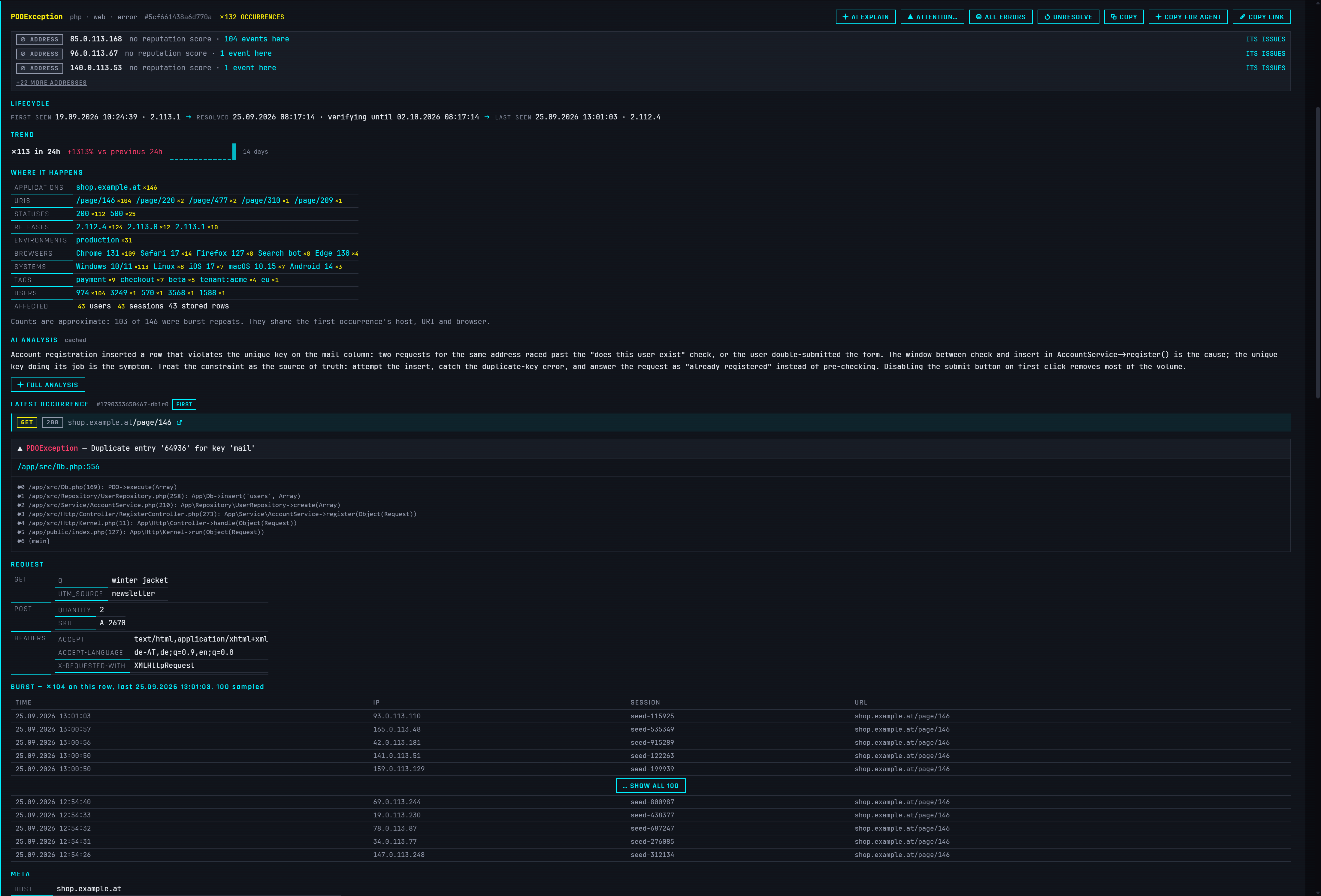
Every error, probe and refused login. One case, with its evidence.
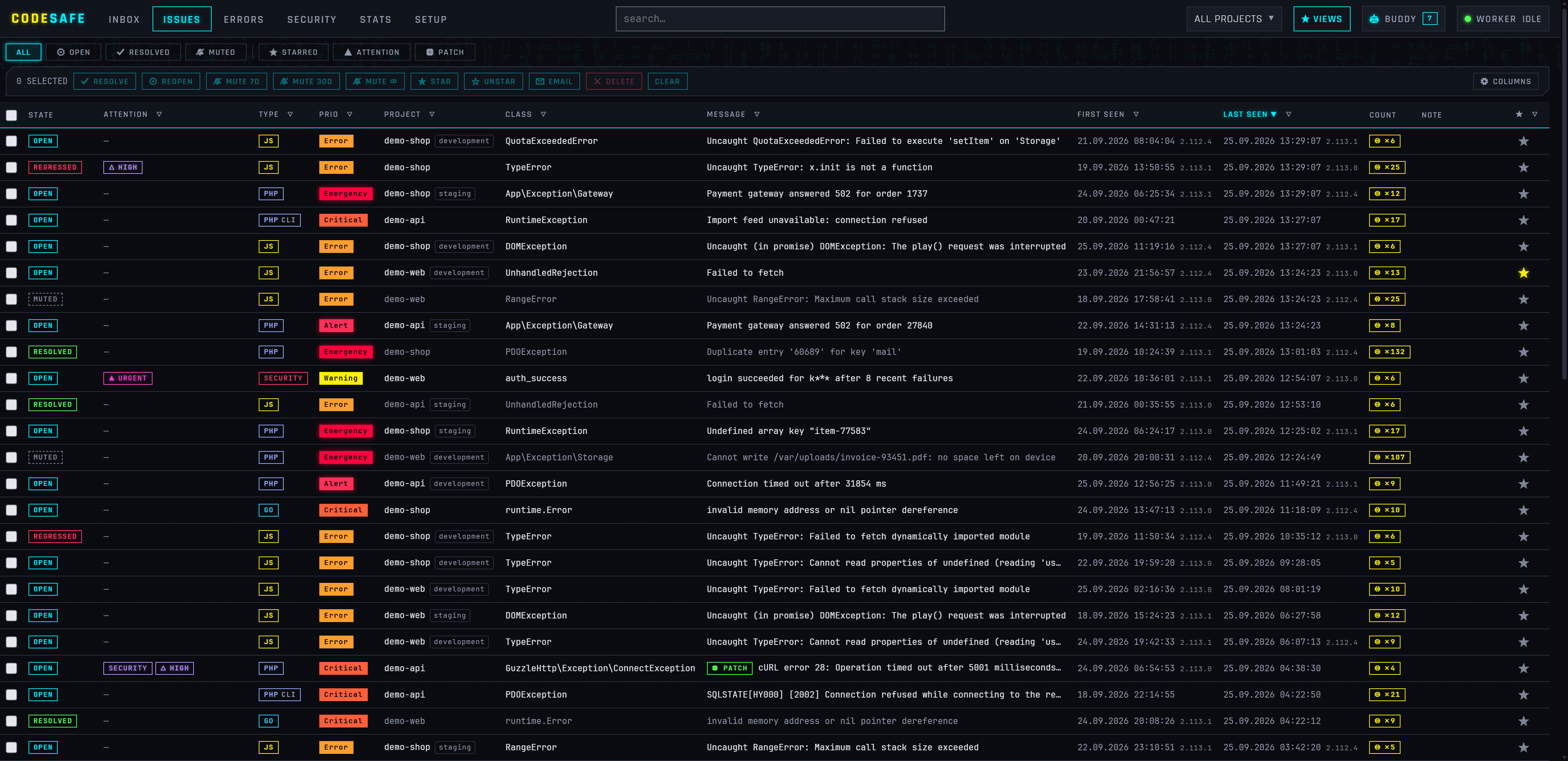
Severity is decided on arrival. Nobody triages a list by hand.
The root cause in plain language. Where it is safe, a patch.
It opens the pull request. It never merges. That stays yours.
It waits for the release. Then it re-runs the request that failed.
A rule that cries wolf loses standing. What slipped past becomes a proposed rule — reviewed, then shipped in the next release.
An attack shows you where you are weak. Read it, and it is a free penetration test.
Your site is probed every day. Most of it is harmless knocking.
One attack in five is an exploit attempt, not a scan.
codesafe keeps that traffic out of your bug list — and reads it.
It names the address, the weak spot and the patch.
Then it re-runs the request, to prove the door is shut.
Measured on our own codesafe, 3–12 September 2026: 27 803 attack events against 9 250 errors, from 285 addresses. The 92% is one AI-driven attacker against one site we maintain — 25 issues surfaced in a morning, 23 of them needing a code change.
Every site pulls its rules from codesafe and judges each request before your code runs. Nothing is refused because a machine decided so.
../../From a CVE advisory, from a probe in your error list, or from the route that was hammered yesterday.
Live on every site, blocking nothing. It counts what it would have stopped — and whom.
A person promotes it. An exploit attempt gets a 403, a hammered endpoint a 429.
A proven rule that refuses your real users is an urgent case. Its one action: demote.
It runs in WordPress (even before WordPress loads), in any ovos/php-library app, in Node and behind any PSR-15 stack, with one rule language for all of them. A project refuses nothing until it is allowed to.
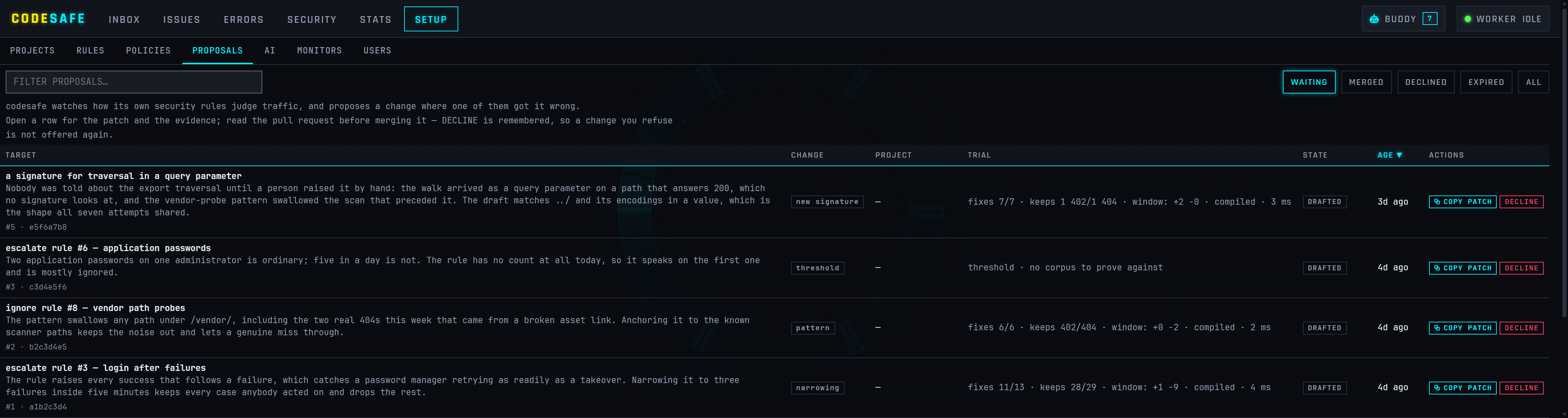
Every night it checks its own rules both ways: what they caught that people marked as wrong, and what slipped past them. A rule that catches the wrong thing is narrowed or retired; what got through becomes a new or wider signature. Each change is tested first, then handed to codesafe's authors as a pull request. Every instance gets what they merge with the next release.
AI reads the requests no signature caught, and keeps what it finds as evidence.
Enough evidence, and it writes the change: a new signature, a tighter one, a rule from an advisory.
The draft runs against everything seen so far — what it would catch, what it would wrongly flag.
A pull request against codesafe's own repository, with the evidence attached and the CI read back.
codesafe's authors review it and merge it, and the next release brings it to every instance. Only a change built on a false report is declined — and it is never proposed again.
An advisory does not wait for a release: its drafted rule can go straight into the Shield of the instance that saw it, accepted by the people who run that instance. Every site pulls it within five minutes, in observe until a person promotes it.
Each one is a thing you would otherwise do by hand, at night.
Errors land in Redis in under a millisecond. Your app serves on.
The same fault collapses into one row with a count.
Impact and urgency are scored on arrival, per project.
A read of your repository, a diff, a pull request. You review.
After the release it re-runs the request that failed. Measured, not claimed.
Cron jobs and pages. You hear it before your users do.
Point Claude at codesafe over MCP — one command. It reads, and it acts.
A drop-in library, a snippet, or a CMS plugin. Your CMS not covered? Tell us — we write the client and integrate it for you.
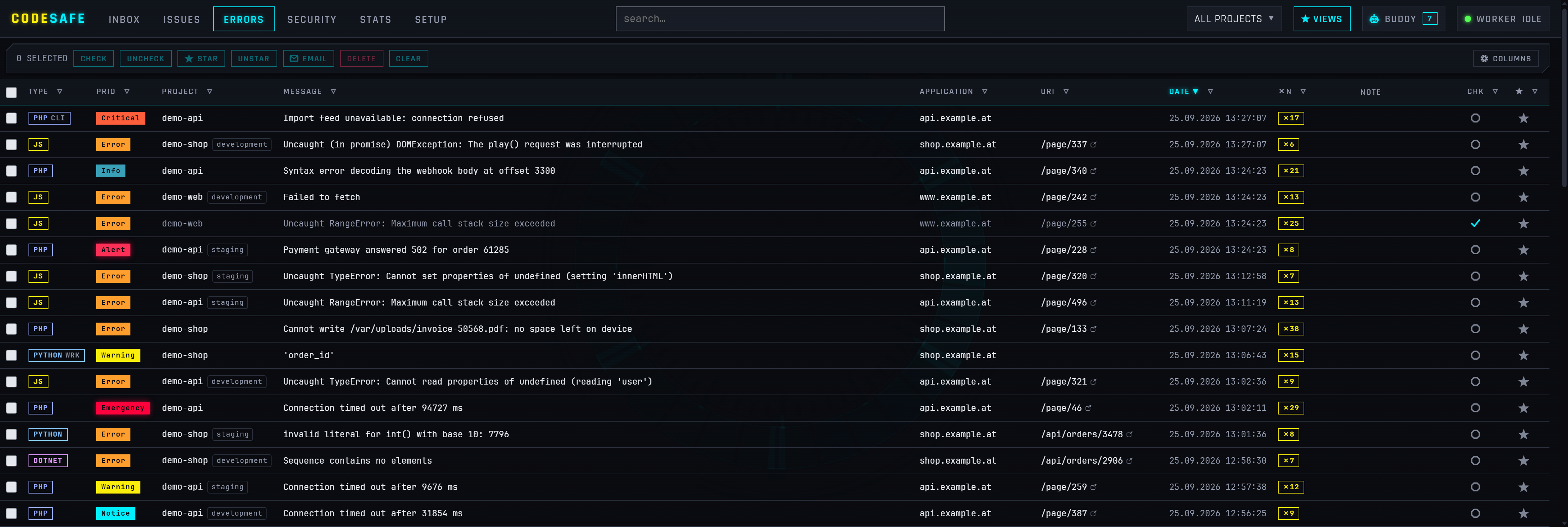
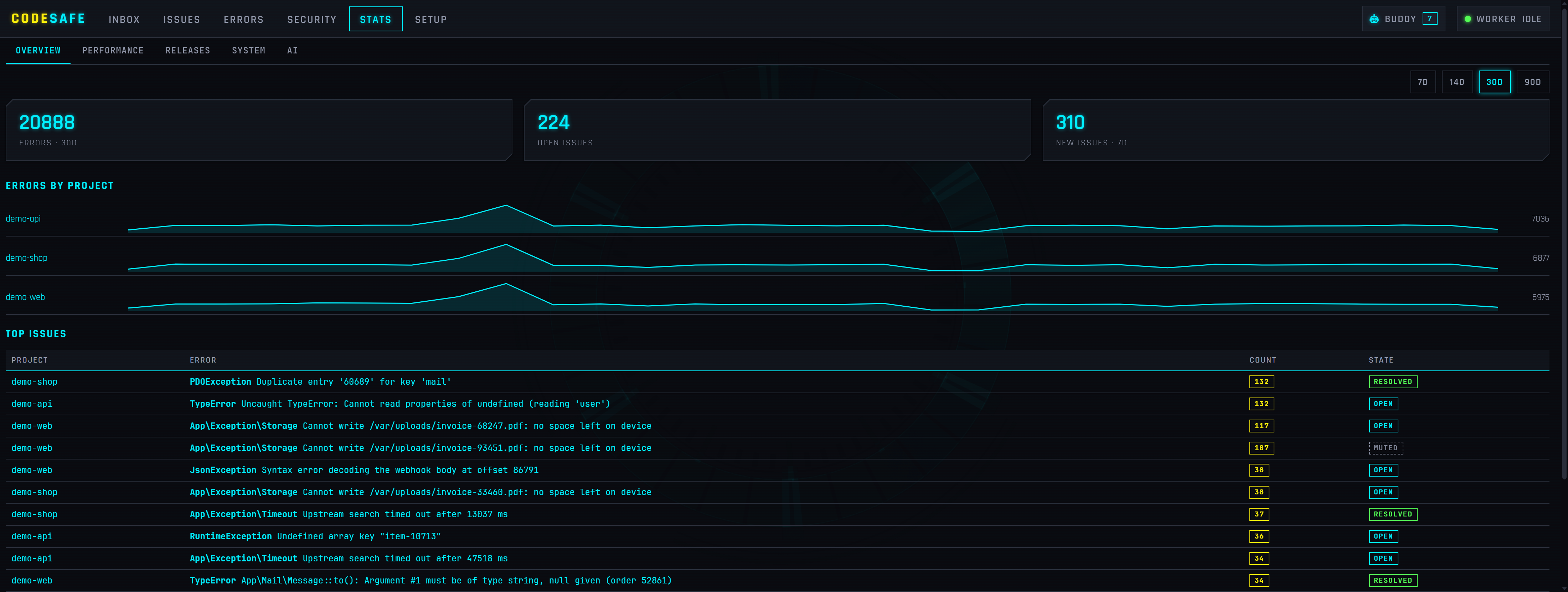
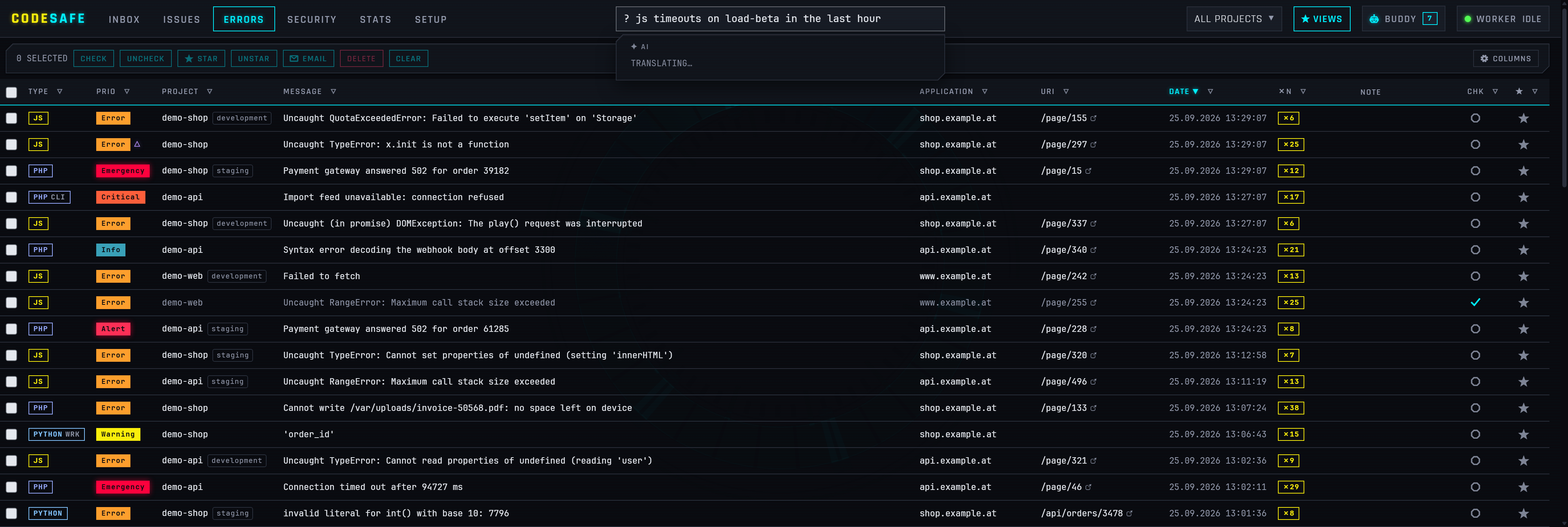
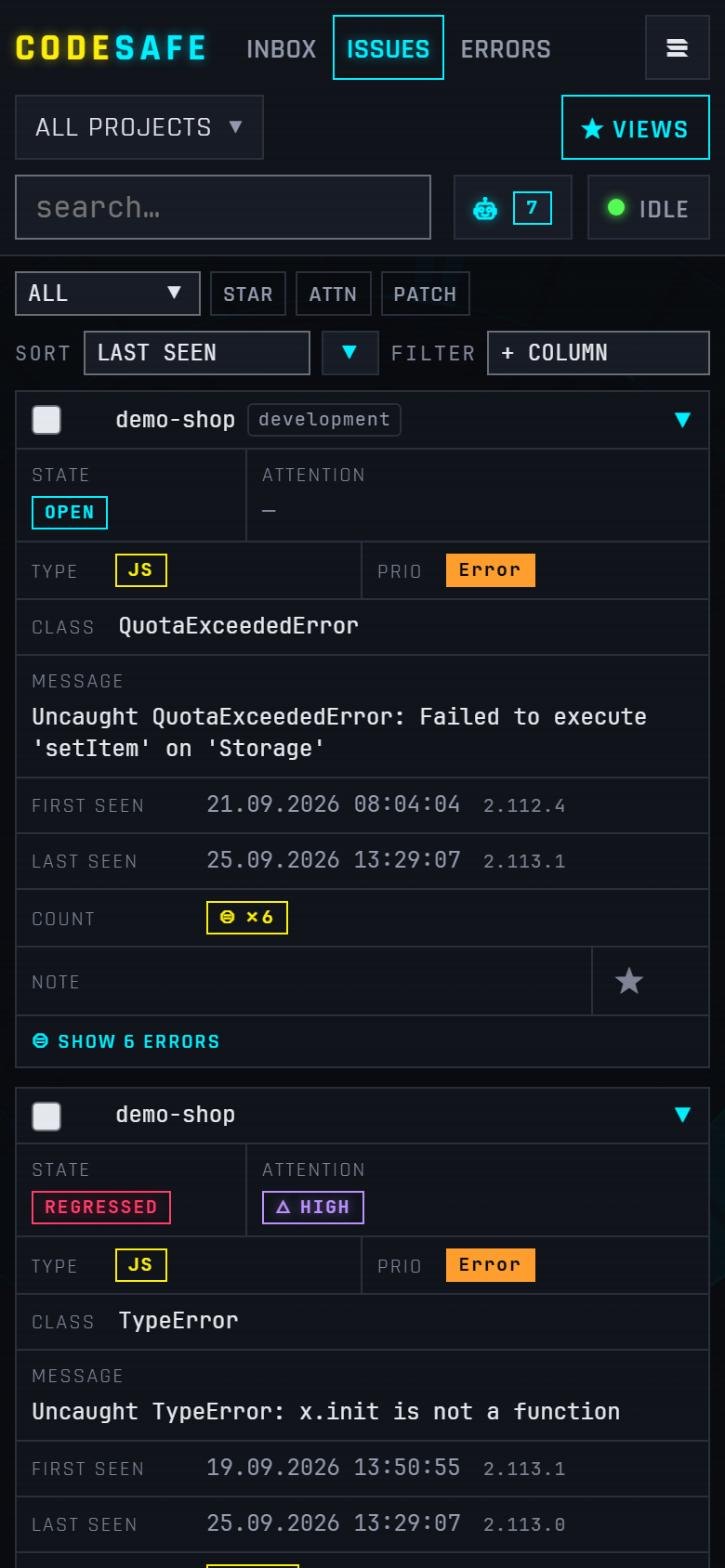
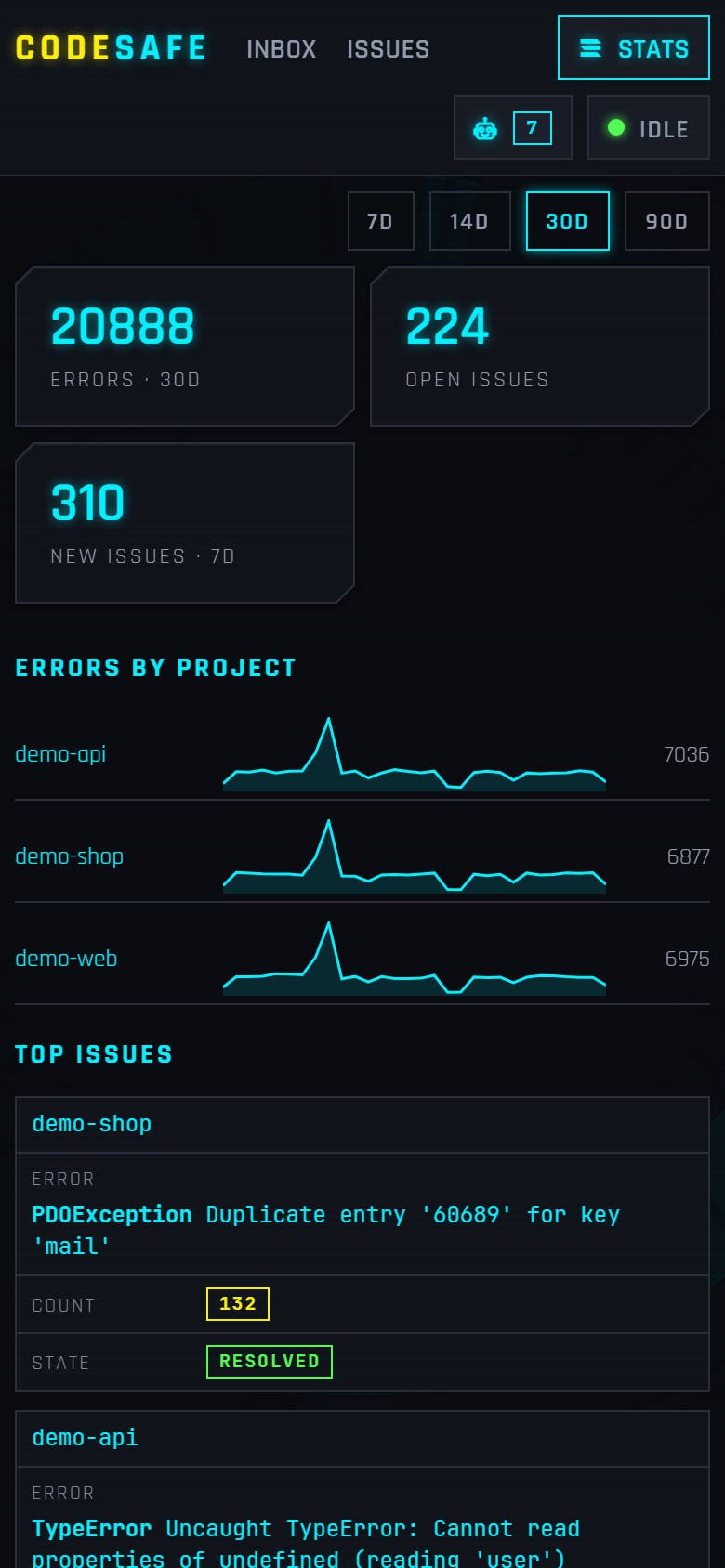
Real screens from a running instance. Nothing mocked.
It is codesafe itself, not a tour of it. Errors, uptime checks and attack waves keep arriving while you read — and you can work them.
codesafe-demo.ovos.at
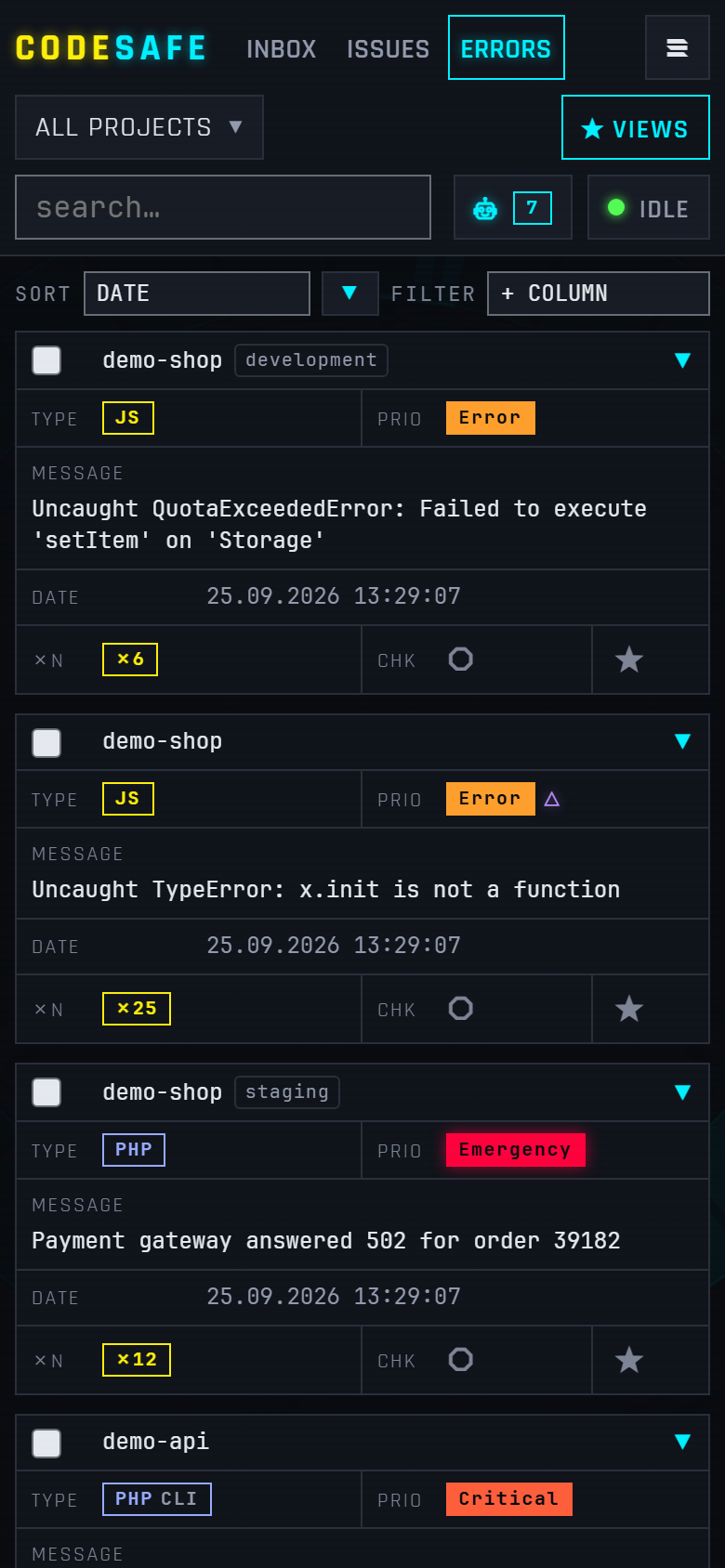
The same codesafe. Grids fold into cards, controls fit a thumb.
If a site is your responsibility, this is for you. One codesafe, however many you run.
Every client site in one codesafe, keyed apart. No bill that grows with the client list.
Every app you run in one place, whatever it is built in. Shipping and watching in the same view.
Install the plugin, paste a key. Errors, probes and plugin CVEs land in one list.
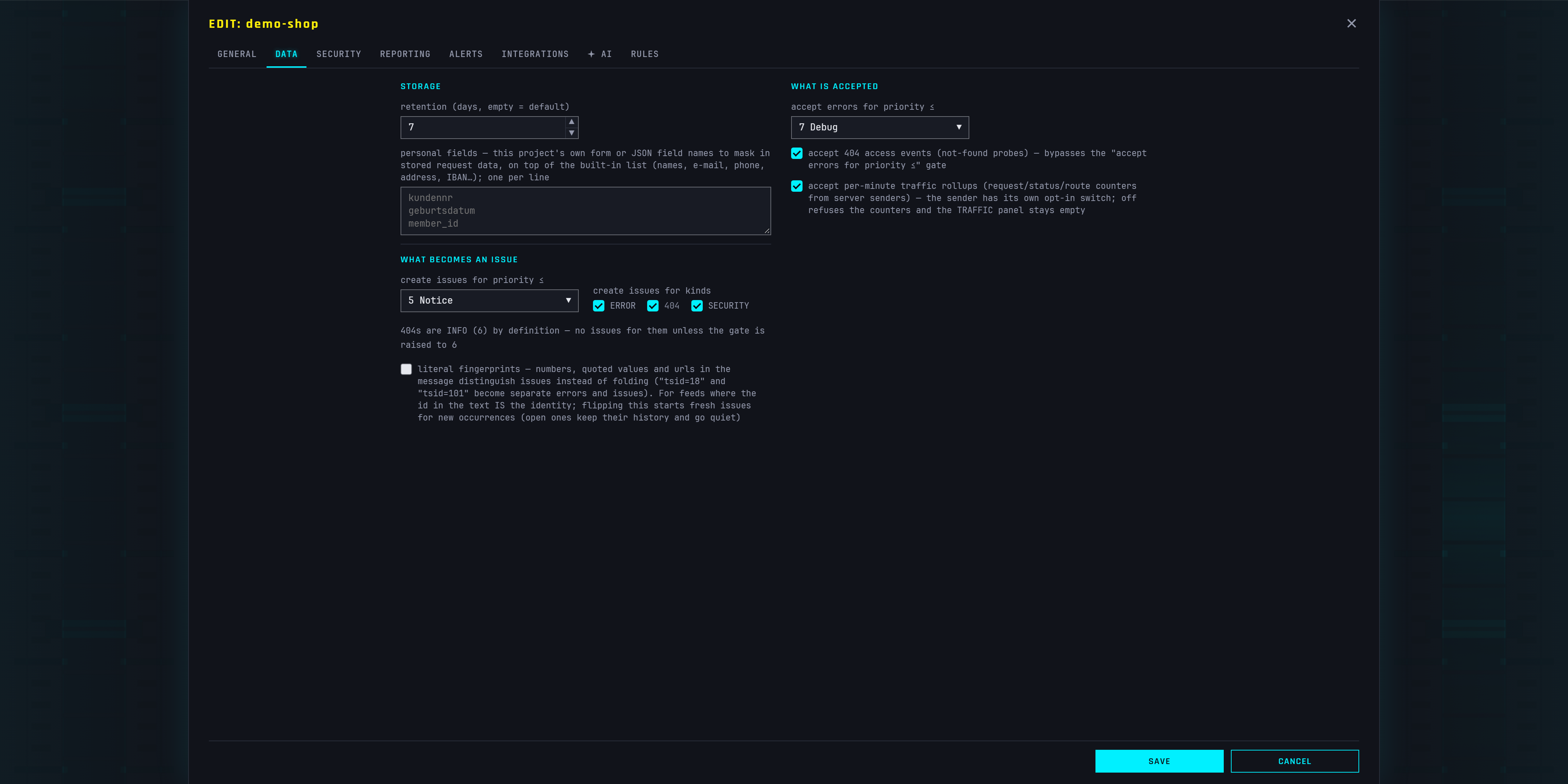
Your own instance, on infrastructure you control. Personal data is masked on arrival; the original is kept encrypted and revealed only with a reason, logged.
Error storms hit Redis, not your app. codesafe indexes behind you.
codesafe does the night shift: it ranks, patches, verifies and only then wakes you.
Not a shared tenancy. The only question is who runs the machine. Before either: the live demo is open to anyone, with no login and nothing to install.
We operate your instance from Vienna, in the EU. You point your apps at it. Nothing else to think about.
office@ovos.atYour data stays inside the building. We set the instance up on your servers and hand you the keys.
Talk to usRunning a CMS we have no client for — TYPO3, Drupal, Shopware, something in-house? We write it and integrate it. Tell us the platform and the version.